Case Study
An appointment confirmation flow that lowers no-shows without pressuring the client
A composite example shows how to combine reminders, careful tone, an easy exit, and outcome tracking to protect the schedule without making confirmation feel pushy.
Jul 20, 2026 · 4 min read · Jeffery Gyamerah
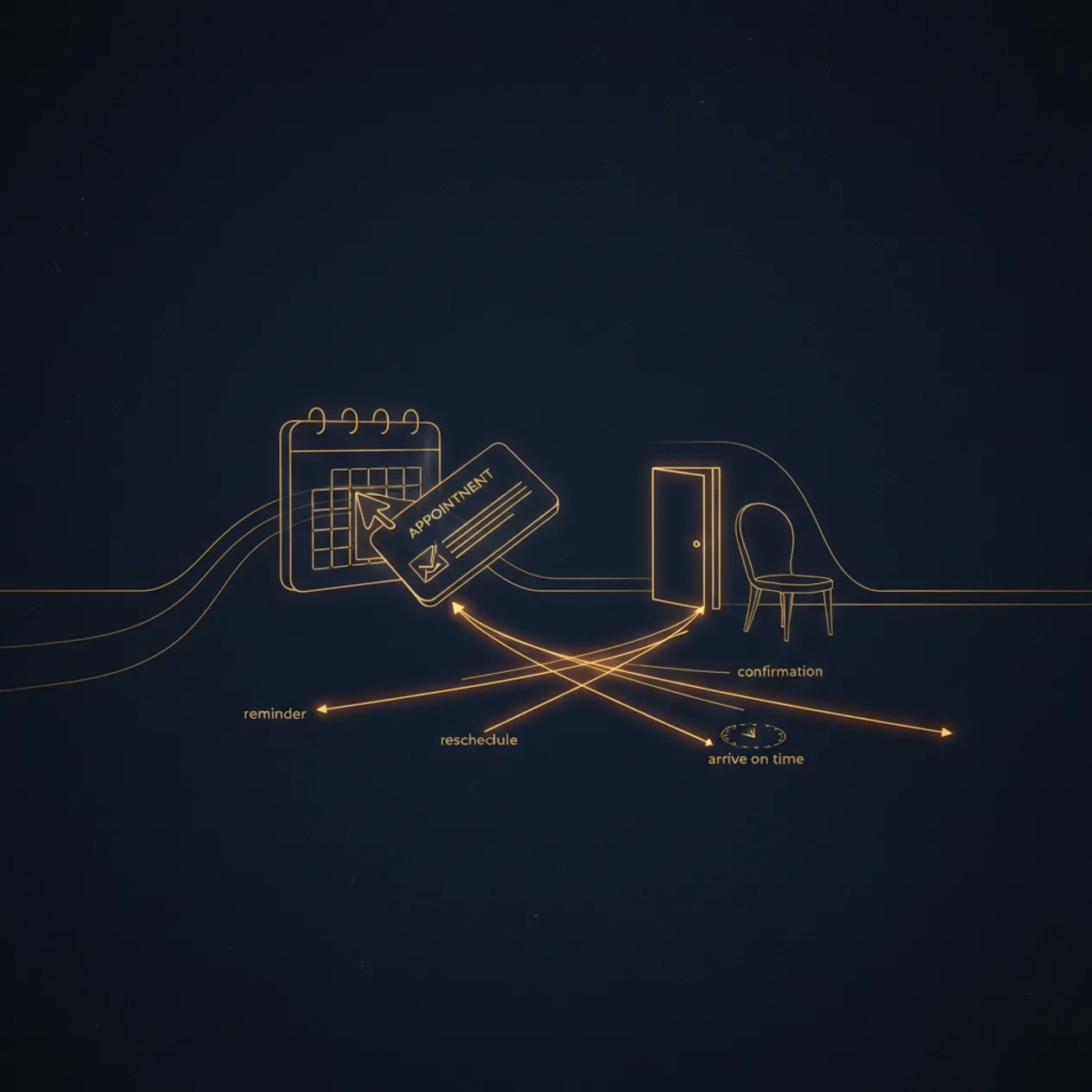
An appointment only has value when the person arrives or gives notice early enough to free the slot. A well-designed confirmation flow lowers no-shows without turning the schedule into a pressure campaign. The difference is in the message and the timing, not in pushing harder.
The issue is usually not bad intent. It is a weak system: generic reminders, poorly timed messages, and no easy way to reschedule or cancel without friction. When that happens, the team ends up chasing confirmations one by one.
The right sequence
A useful flow does not start on the day of the appointment. It starts the moment the booking is made, with a short message that confirms the date, time, location, and contact method. That first message is not trying to sell anything; it simply makes the details clear and reduces doubt.
After that comes a simple cadence. For example: immediate confirmation when the booking is made, a gentle reminder 48 hours before, and another one on the same day for high-value or time-sensitive appointments. The goal is not to insist more, but to reach the person while there is still time to act.
If your team already feels like it is confirming too much, the problem is probably not the number of messages. It is the lack of a defined sequence. Three well-timed touches usually work better than eight improvised pings.
The tone that does not push
The difference between a useful reminder and an annoying one is how it is written. A good message assumes good faith, avoids guilt, and uses practical language: what the appointment is, when it is, and what to do if plans changed. That keeps the relationship calm before the visit even happens.
A composite example could read: "Just a friendly reminder of your appointment tomorrow at 10:00. If you need to move it, reply RESCHEDULE and we will help". That kind of text reduces friction because the person does not need to explain much to take a simple step.
Confirmation should protect the schedule without making the client feel like they owe you a reply.
The easy exit
The best way to avoid a silent no-show is to make early notice easy. An escape hatch is not a trick; it is a visible route to reschedule, cancel, or ask for help. It can be a keyword, a direct link, or a short reply that routes the message to the team.
That detail changes the dynamic. Instead of pushing the client toward silence, the flow offers a respectful alternative. For the business, that means fewer last-minute gaps and less time wasted chasing replies that never come.
Measuring what matters
A flow like this only improves when it is reviewed with discipline. It is not enough to know how many messages were sent; you need to see how many appointments were confirmed, how many were rescheduled in time, how many were cancelled with notice, and how many never got a reply.
That tracking lets you tune both cadence and wording. If the same-day reminder creates silence, it may be arriving too late. If the first message triggers too many questions, it may be hiding information that should be visible at booking.
A business can review its flow every week with a simple sheet: booked, confirmed, rescheduled, cancelled, no response. Within a few weeks, the pattern shows whether the problem is the message, the timing, or the channel.
Work with AdwenTech
If your schedule loses value to avoidable no-shows, we can help you design a confirmation flow that respects the client and protects the operation. At AdwenTech, we build practical automation systems with clear cadence, simple exit paths, and tracking that actually helps the business. If you want to review your current flow, visit our contact page to start the process.