panama-business
A Panama business example of lead follow-up across channels
A local Panama example shows how web forms and email can power one unified lead system while WhatsApp stays a human-answered channel.
May 26, 2026 · 6 min read · Jeffery Gyamerah
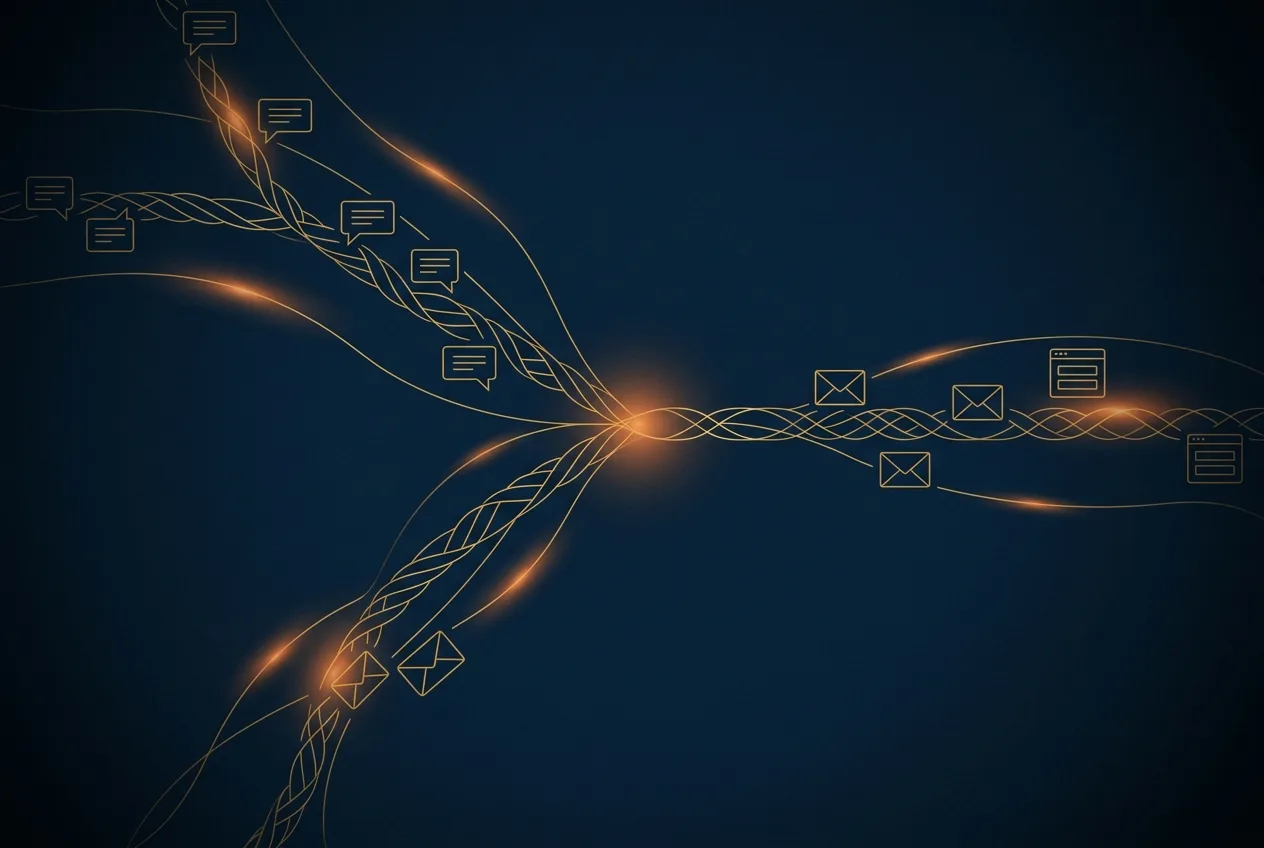
A potential client uses your business's wa.me link and a person answers. Another fills out the contact form on your website. A third replies to an email campaign.
These are all positive signals—signs of interest. Yet for many service businesses in Panama, each new inquiry adds friction to your operations. Without a central system, managing conversations across channels becomes manual, error-prone, and costly.
Leads slip through the cracks. The challenge isn't a lack of inquiries; it's the lack of a unified process to handle them professionally.
The multichannel reality for Panama businesses
In Panama, business communication is diverse. WhatsApp can be an important channel for customer service, sales inquiries, and appointment booking when the team answers personally. Alongside it, businesses receive inquiries through several other channels:
- Website forms for detailed requests
- Direct emails for formal communication
- Phone calls for immediate needs
Each channel serves a purpose. The problem emerges when channels operate in silos: a WhatsApp inquiry might be handled by one team member on their phone, while a website submission lands in a general inbox monitored by another.
Information gets copied manually into a spreadsheet. Follow-ups become inconsistent because there's no single source of truth for who was contacted, when, and what the next step should be.
This has a direct financial cost:
- A lead not followed up promptly goes to a competitor.
- A potential client who repeats their story to three people feels the business is disorganized.
- Time spent on manual data entry is time not spent on revenue-generating activities.
Your internal process is dictated by the channel, rather than having one robust process that handles all channels.
Mapping the flow: A composite example
Imagine a mid-sized consulting firm in Panama City offering corporate legal services. They generate leads from three main sources: a wa.me link answered by a person on their social media profiles, a "Request a Consultation" form on their website, and emails to their main info@ address. For years, their process has been entirely manual and disconnected.
When a message arrives through wa.me, the administrative assistant sees it on the company phone and answers basic questions. They can then log the interest in a short internal form. If a website form is submitted, a notification goes to the info@ inbox and the intended record is created.
The same assistant reviews the email and completes only what is missing. Direct emails follow the same path. The CRM or spreadsheet becomes the master list, with a clear rule so no inquiry is left out.
The channel a lead uses to contact you reflects their preference, not yours. The operational challenge is to meet them there without fragmenting your own internal process.
The breakdown of a manual process
Now suppose the managing partner wants an update on new leads from the last week. The assistant must manually filter the spreadsheet, cross-reference emails, and check WhatsApp chat history to ensure nothing was missed. It's time-consuming and stressful.
If the assistant is sick or on vacation, the entire process stalls. A high-value lead from a Friday afternoon WhatsApp message could easily be forgotten until Tuesday, by which time the prospect has already engaged another firm.
Does your team have one single place to see all new inquiries from the last 7 days, regardless of whether they came from WhatsApp, email, or your website?
Unifying the channels into a single rhythm
The solution is not to force all clients into one channel. It is to build an internal system that captures website and email entries automatically. Human conversations are easily recorded in one central place. This is strategic modernization: using technology to create a simpler, more reliable, and more profitable way of working.
For the consulting firm, a unified system would work very differently. A modern CRM platform or well-designed automated database serves as the central hub. When the website form is submitted, it automatically creates a lead record, assigns it to a specific lawyer, and schedules a follow-up task.
Emails to the info@ address can be configured to do the same. Manual data entry is eliminated where content arrives through the form or email.
WhatsApp should keep a simple boundary. The team answers the wa.me link personally and, before the shift ends, records the name, email, and interest in the internal form or asks the client to complete the intake form.
A simple, lower-cost approach: establish firm discipline—all WhatsApp inquiries must be recorded in the central system through a simple form by end of day.
Even this brief human step, tied to a central system, is a significant improvement.
The goal is a single source of truth. With it, the managing partner sees the entire sales pipeline at a glance, follow-up tasks are never missed, and every prospect receives the same professional level of service, regardless of how they first reached out.
Work with AdwenTech
Designing and implementing a unified lead management system requires careful planning and technical execution. AdwenTech specializes in helping service businesses in Panama modernize their operations.
We analyze your current workflow, identify friction points, and build practical automation solutions for forms, email, and internal coordination that free up your team. To discuss how we can build a more resilient process for your business, please contact us or learn more about our Automation & Process Modernization services.